




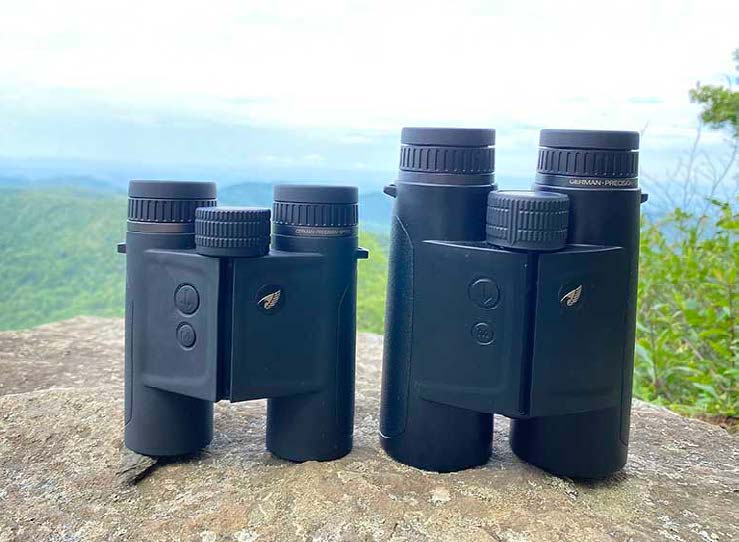
From lightweight bowhunting setups to premium glass and do-it-all optics that can carry over into rifle season, these six rangefinding binoculars cover the hunting situations where combining your binocular and rangefinder makes the most sense.
Quick take: The Leupold BX-4 Range HD Gen 2 is my best overall rangefinding binocular for bowhunting because Archer’s Advantage is built around an actual bow-and-arrow setup. The SIG SAUER Canyon offers the best value around $800, while the GPO RangeGuide 10×32 is my favorite lightweight option. Hunters who also rifle hunt should look hard at the SIG KILO6K HDX and Vortex Ranger, while the Leica Geovid Pro gets my vote when premium glass is the priority.
One thing I learned pretty quickly when I started getting more serious about bowhunting is that judging distance with your eyes is a great way to convince yourself a deer is 30 yards away when it is actually 38.
With a rifle, eight yards might not change much. With a bow, it absolutely can.
That’s what originally made rangefinding binoculars interesting to me. Instead of glassing an animal, dropping the binoculars, grabbing a separate rangefinder, finding the animal again and finally getting a distance, I can do both jobs through one optic.
It sounds like a small improvement until a bull is moving through timber or a whitetail is approaching a shooting lane. At that point, fewer movements and fewer pieces of gear suddenly make a lot of sense.
One problem: rangefinding binoculars are expensive. Once I started comparing the current options, I also noticed that most of the marketing revolves around how many thousands of yards they can range.
I don’t really care if my binocular can range something at 6,000 yards when the deer I want to shoot is standing at 37.
So for this guide, I looked harder at the features that actually matter to me as a bowhunter: angle compensation, close-range performance, speed, optical quality, weight, ease of use and whether the technology actually improves an archery hunting setup.
Jump to a Section
My Picks at a Glance
Leupold BX-4 Range HD Gen 2 10×42
Bow-specific Archer’s Advantage technology in a premium 10×42 hunting optic.
SIG SAUER Canyon 10×42
A dedicated Archery Mode and useful 10×42 configuration without a four-figure price.
GPO RangeGuide 10×32
Only 24 ounces with a 6-yard minimum range for mobile bowhunting.
SIG SAUER KILO6K HDX 10×42
Archery Mode, environmental sensors and connected technology in a surprisingly light package.
Leica Geovid Pro 10×42
Premium optics for hunters who spend far more time glassing than pressing the range button.
Vortex Ranger HD 3000 10×42
A 6-yard minimum range and HCD angle compensation for bow and rifle hunting.
Rangefinding Binocular Comparison
This table focuses on the specifications that matter most to a bowhunter. Maximum ranging distance is useful, but I placed more importance on minimum range, archery functionality, weight and overall value.
On a phone or narrow screen, swipe the table left to see every specification.
| Award | Rangefinding Binocular | Configuration | Weight | Minimum Range | Archery Feature | Approx. Price | Best For |
|---|---|---|---|---|---|---|---|
| Best Overall | Leupold BX-4 Range HD Gen 2 | 10×42 | 37 oz. | 12 yds. | Archer’s Advantage and Bow Mode | $1,799.99 | Dedicated bowhunters wanting premium glass and bow-specific technology |
| Best Value | SIG SAUER Canyon | 10×42 | 29 oz. | Short-range capable | Dedicated Archery Mode | $799.99 | Bowhunters wanting rangefinding binoculars for less than $1,000 |
| Best Lightweight | GPO RangeGuide | 10×32 | 24 oz. | 6 yds. | True-Range Angle compensation | $1,049.99+ | Mobile elk and whitetail hunters prioritizing low weight |
| Best Technology | SIG SAUER KILO6K HDX | 10×42 | 24.7 oz. | Short-range capable | Archery Mode and connected technology | $999.99 | Bow and rifle hunters wanting advanced connected features |
| Best Premium Glass | Leica Geovid Pro | 10×42 | 34.2 oz. | 10 yds. | Equivalent Horizontal Range | $2,999+ | Western hunters who prioritize optical quality |
| Best Bow/Rifle Crossover | Vortex Ranger HD 3000 | 10×42 | 32.4 oz. | 6 yds. | HCD angle compensation | $799.99 street price | Bow and rifle hunters wanting simple angle compensation without paying for an advanced ballistic solver |
The Best Rangefinding Binoculars of 2026
Each binocular below solves a slightly different hunting problem. I would use the award, weight, archery features and tradeoffs to decide which one makes the most sense for the way you actually hunt.
Leupold BX-4 Range HD Gen 2 10×42
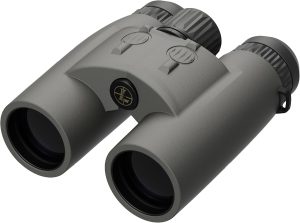

The BX-4 Range HD Gen 2 is my best overall choice because Leupold put real thought into how a bowhunter uses a rangefinding binocular.
The feature that separates this one for me is Archer’s Advantage.
Rather than only calculating generic angle compensation, the system can use information from your bow setup, including arrow weight, arrow velocity and peep height.
That’s the kind of technology I actually care about.
Leupold says the 10×42 can range deer-sized targets well beyond any distance I would ever consider shooting an arrow, but that’s not why I would buy it. I want the correct number when I’m shooting steeply downhill from a treestand or trying to decide whether an elk is standing at 42 or 48 yards.
The other half of the equation is that this still needs to work as my binocular.
The 10×42 configuration gives me a versatile hunting optic, and Leupold’s optical system is designed around low-light performance, glare reduction and clarity.
The downside is hard to miss: 37 ounces.
For treestand hunting, I wouldn’t worry much about it. If I were climbing several thousand vertical feet every day on an elk hunt, that weight would make the SIG KILO6K or GPO much more tempting.
Why it stands out: Archer’s Advantage gives bowhunters a customized ranging mode based on their own equipment instead of a generic rifle-first ballistic solution.
Best use: Bowhunters who want a premium all-around 10×42 binocular with the most archery-specific ranging technology in this group.
Reasons to Buy
- Archer’s Advantage uses information from your bow setup
- Dedicated Bow Mode
- Premium 10×42 hunting configuration
- Strong low-light emphasis
- Red OLED display
- Tripod compatible
Reasons to Consider
- 37 ounces is heavy
- Premium price
- 12-yard minimum is not as close as the GPO or Vortex
SIG SAUER Canyon 10×42
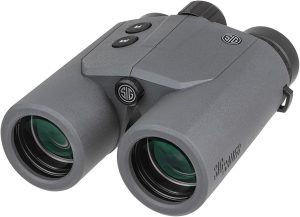

Rangefinding binoculars have always been a little difficult for me to justify because a good pair can cost as much as a flagship bow.
The Canyon changes that conversation.
At roughly $800, it is still an expensive optic, but it’s dramatically easier to swallow than $1,800 or $3,000.
More importantly, SIG did not remove the part I care about.
The Canyon includes a dedicated Archery Mode designed to produce a useful shoot-to distance on angled shots. It also offers fast scan capability for updating distances as an animal moves.
That makes a lot of sense for elk hunting.
A bull can move from 62 yards to 48 surprisingly quickly. Being able to stay in the binocular and keep updating the range is one of the strongest arguments for this entire category.
At 29 ounces, the Canyon isn’t ultralight, but I consider that a reasonable weight for a full-size 10×42 rangefinding binocular.
I would not expect the optical performance to compete directly with something like the Leica, but that isn’t really the comparison I’m making.
This is the option for someone who wants the functionality without spending premium-glass money.
Why it stands out: It gives bowhunters a dedicated Archery Mode and full-size 10×42 configuration for hundreds less than most premium rangefinding binoculars.
Best use: Bowhunters who want to combine their binocular and rangefinder without immediately entering the $1,500-plus price tier.
Reasons to Buy
- Strong price for the category
- Dedicated Archery Mode
- Full-size 10×42 configuration
- Fast scan capability
- Reasonable 29-ounce weight
Reasons to Consider
- Not positioned as premium Leica-level glass
- Fewer advanced features than the KILO6K HDX
- Hunters already near a $1,000 budget may prefer stepping up
GPO RangeGuide 10×32
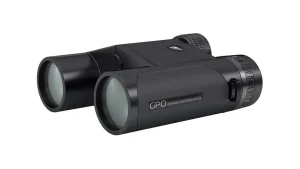

GPO gets an extra look here because North American Bow Hunter has already spent time with the RangeGuide platform in the field.
Mike Hungle previously wrote about using the RangeGuide and came away liking the same thing that attracted me to these binoculars in the first place: getting rid of one extra optic hanging around your chest.
The version I would look hardest at today is the 10×32.
The reason is simple: 24 ounces.
Everything in my pack feels light when I pick it up individually. Put everything together and hike through elk country for a day and that changes quickly.
The RangeGuide also ranges down to roughly 6 yards.
That number catches my attention much faster than the multi-thousand-yard maximum.
The obvious tradeoff is moving from a 42mm objective to 32mm. For extended glassing right at dawn and dusk, I would generally prefer more objective lens.
For a mobile bowhunter trying to reduce bulk and weight, however, I think the trade makes sense.
Why it stands out: It combines one of the lightest weights in the roundup with one of the closest minimum ranging distances.
Best use: Mobile whitetail hunters, elk hunters and anyone who places a high value on keeping the bino harness light.
Reasons to Buy
- Only 24 ounces
- 6-yard minimum range
- Compact 10×32 design
- Angle compensation
- Previous RangeGuide field experience from our team
Reasons to Consider
- 32mm objective gives up some low-light potential
- Less connected technology than SIG’s premium models
- Costs more than the Canyon
SIG SAUER KILO6K HDX 10×42
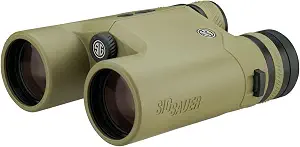

The KILO6K HDX earns the Best Technology award because it does considerably more than provide a basic line-of-sight distance.
For bowhunting, its dedicated Archery Mode calculates an angle-adjusted shoot-to distance for shots inside 150 yards. It also displays the angle of the shot, helping a bowhunter understand how steep terrain or an elevated stand affects the range.
The binocular also includes Applied Ballistics Ultralite for rifle hunting. This system uses information about the rifle, cartridge and shooting conditions to provide ballistic solutions at longer distances.
Built-in environmental sensors measure factors such as temperature, air pressure and elevation. Those readings can be incorporated into the ballistic calculation instead of requiring the hunter to estimate the conditions.
Bluetooth connectivity brings the KILO6K into SIG’s BDX ecosystem. It can communicate with compatible SIG optics and the SIG BDX mobile app, where a hunter can create and manage ballistic profiles. When paired with a compatible BDX riflescope, ranging information can be transferred to the scope to provide a corrected aiming point.
The KILO6K also features a fast ranging engine and scan mode, allowing the displayed distance to update as an animal moves or as the hunter ranges several objects across the landscape.
Not every bowhunter needs that entire system. If I only wanted a straightforward angle-compensated distance, the Canyon would cover the essential job for less money. But for someone who bowhunts and rifle hunts, the KILO6K offers a deeper set of tools that can serve both seasons.
Why it stands out: The KILO6K combines Archery Mode, Applied Ballistics Ultralite, onboard environmental sensors, Bluetooth connectivity and integration with compatible SIG BDX optics in a lightweight 10×42 binoculars.
Archery Mode
Applied Ballistics Ultralite
Bluetooth + SIG BDX
Onboard Sensors
Bowhunters who also rifle hunt and want one lightweight rangefinding binocular with archery calculations, ballistic solutions, environmental data and connected-optic capability.
Reasons to Buy
- Archery Mode provides angle-adjusted shoot-to distances
- Applied Ballistics Ultralite supports rifle-season solutions
- Built-in sensors account for environmental conditions
- Bluetooth connects with the SIG BDX app and compatible optics
- Scan mode updates distances as an animal moves
- Lightweight 10×42 design
- Strong technology package for around $1,000
Reasons to Consider
- More technology than a bow-only hunter may need
- Connected features require some initial setup
- Several major advantages apply primarily to rifle hunting
- The SIG Canyon covers the essential archery job for less
- App integration may not appeal to hunters who prefer simple optics
Leica Geovid Pro 10×42
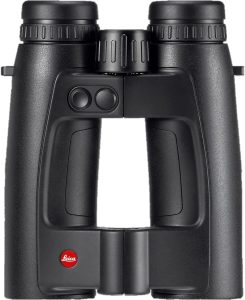

There is a point where shopping for rangefinding binoculars stops being about how much electronic technology I can get for the money.
It becomes about the view.
That’s where Leica fits.
If I’m spending hours picking apart a mountainside for bedded mule deer or trying to find an elk tucked into dark timber, the quality of the binocular matters every minute I’m behind it. The laser only matters when I press the button.
That is why glass quality can’t become an afterthought in this category.
The Geovid Pro still gives me the electronic features I expect from a premium rangefinding binocular, including angle-related ranging and connected ballistic functionality.
But the bigger reason to spend Leica money is that I want Leica glass hanging around my neck all day.
The drawback is also pretty obvious.
At roughly $3,000 depending on configuration and current pricing, this is not a casual purchase.
For someone who mostly hunts the same whitetail property, I would put that money somewhere else.
For the western hunter who spends hours behind binoculars on every hunt, I understand the appeal much more.
Why it stands out: The Geovid approaches the category as a premium binocular with a sophisticated rangefinder rather than an electronic rangefinder that also happens to magnify.
Best use: Serious western bowhunters who glass for hours and place optical quality above price.
Reasons to Buy
- Premium optical quality
- Strong low-light capability
- 10-yard minimum range
- Equivalent Horizontal Range
- Premium construction
- Useful rifle-season crossover
Reasons to Consider
- Very expensive
- Heavier than several competitors
- Bow-specific technology isn’t the primary selling point
Vortex Ranger HD 3000 10×42
Bottom line
The Ranger HD 3000 gives bowhunters the close-range performance and angle compensation they need while remaining useful during rifle season—without charging them for an advanced ballistic solver they may never use.
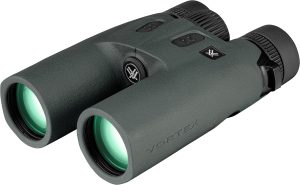

The Vortex Ranger HD 3000 is the model I would recommend to hunters who want one straightforward rangefinding binocular for both bow and rifle season at a more affordable price as well as what Vortex is known for – the best warranty system in hunting gear.
The number that matters most to me is not the 3,000-yard maximum reflective range. It is the 6-yard minimum range.
That gives the Ranger legitimate usefulness around treestands, shooting lanes and normal bowhunting distances. I can range a nearby tree before an animal arrives or quickly check the distance when a deer changes direction inside my effective range.
Vortex’s Horizontal Component Distance mode, better known as HCD, provides an angle-compensated shoot-to distance. That makes the displayed number useful when shooting from an elevated stand or across sloped terrain.
The ranging system also includes Scan, First and Last target modes. First Mode can help isolate a closer target, while Last Mode is useful when an animal is standing behind brush, branches or other objects that could interfere with the laser reading.
Once rifle season begins, the Ranger can range deer-sized targets out to 1,500 yards and reflective targets out to 3,000 yards. It does not calculate a complete ballistic solution like the more expensive Vortex Fury HD 5000 AB, but that may be an advantage for hunters who want a faster and less complicated display.
At 32.4 ounces, the Ranger is heavier than the SIG KILO6K HDX and GPO RangeGuide. However, the weight is still reasonable for a full-size 10×42 rangefinding binocular, especially when it replaces both a binocular and a separate handheld rangefinder.
The HD optical system, red OLED display, waterproof construction and included GlassPak harness round out a practical hunting package. Vortex’s unlimited, unconditional lifetime warranty is another meaningful advantage when buying an electronic optic expected to spend years in rough hunting conditions.
Why It Stands Out
The Ranger combines a bow-friendly 6-yard minimum range, HCD angle compensation and useful target-selection modes with enough ranging capability for rifle season. It delivers the crossover features most hunters will actually use without requiring them to pay for an advanced ballistic computer.
10×42
32.4 oz.
6 yds.
Up to 1,500 yds.
HCD Angle Compensation
Normal, First and Last
Best for
Bowhunters who also rifle hunt and want uncomplicated angle compensation, useful close-range performance and a strong warranty without paying for an advanced ballistic solver.
Reasons to Buy
- 6-yard minimum ranging distance
- HCD angle-compensated shoot-to range
- Normal, First and Last target modes
- Scan mode for moving animals
- 10×42 HD optical system
- Useful for both bow and rifle seasons
- Unlimited lifetime Vortex warranty
Reasons to Consider
- 32.4 ounces is heavier than the SIG and GPO options
- No dedicated bow-profile system like Archer’s Advantage
- Does not include an advanced ballistic solver
- Optical quality is not positioned against premium Leica glass
How I Chose the Best Laser Rangefinding Binoculars
No single rangefinding binocular can honestly be called the best for every bowhunter.
A guy sitting in the same whitetail stand all November doesn’t need the same optic as someone chasing elk five miles from the truck. A hunter who puts away his bow when rifle season starts also has less reason to pay for advanced ballistic software than someone who hunts with both.
For that reason, I compared each binocular according to the job it is designed to do rather than simply ranking them from most expensive to least expensive.
I also want to be clear about the testing behind this article. I have not personally carried all six of these binoculars through a full hunting season side-by-side. My selections combine current manufacturer specifications, bowhunting-specific functionality, optical features, weight, price and previous experience from our team. North American Bow Hunter has previously used the GPO RangeGuide platform in the field, which gives us additional firsthand context for the real advantage of combining binoculars and a rangefinder.
Close-Range Performance
A 6,000-yard maximum range looks great in an advertisement. It isn’t what determines whether I want to carry the binocular while bowhunting.
I paid closer attention to the other end of the range. A bowhunter needs to be able to range trees, rocks, shooting lanes and animals at normal archery distances.
Angle Compensation
This is one feature I would consider mandatory.
Tree stands, ravines and mountain terrain can all create steep shooting angles. I want a rangefinding binocular that gives me useful information for the shot rather than only straight-line distance.
Weight
Rangefinding binoculars live in a chest harness for hours at a time. That made the difference between a 24-ounce binocular and a 37-ounce binocular more important to me than it might look on a specification chart.
Optical Quality
A laser rangefinder doesn’t excuse bad binoculars.
If I’m replacing two optics with one in my optics setup, I want something I am actually comfortable glassing through for hours.
Purpose and Value
I rewarded products that solve noticeably different hunting problems. That’s why an $800 SIG Canyon can earn a category alongside a $3,000 Leica instead of pretending the more expensive binocular is automatically the better buy for everyone.
How to Choose Rangefinding Binoculars for Bowhunting
Start With How You Actually Hunt
Before looking at laser range or ballistic software, I would ask one question: Where do I spend most of my hunting season?
If I’m primarily in a treestand, I value close-range performance, angle compensation and a manageable field of view.
If I’m hunting elk or mule deer out West, weight, optical quality and the ability to glass for long periods become much more important.
If I bowhunt and rifle hunt, then the more advanced ballistic systems start making sense.
Minimum Range Matters More Than You Think
This is one of the biggest differences between the way I would shop for bowhunting binoculars and the way a long-range rifle hunter might shop.
I care a lot more about whether a binocular works at 10 yards than whether it works at 7,000.
The Vortex Ranger and GPO RangeGuide 10×32 starts at 6 yards. Those are meaningful numbers for archery.
Angle Compensation Is Essential
Nearly every binocular in this guide handles angle in some way, but the systems aren’t identical.
Leupold’s Archer’s Advantage is especially interesting because it goes beyond generic angle compensation and incorporates information about your actual bow setup.
SIG offers a dedicated Archery Mode, while GPO, Leica and Vortex use their own angle-compensating systems.
10×42 Is Still the Safest All-Around Size
If I were buying one binocular for just about everything, I’d start with 10×42.
It gives me enough magnification for western glassing while still being perfectly usable from a whitetail stand.
The GPO 10×32 makes a deliberate tradeoff. You give up some objective-lens size for a noticeably lighter and more compact binocular.
Rangefinding binoculars are only one part of a complete setup. Our guide to must-have deer hunting gear explains how magnification, objective-lens size and other optics choices fit into the larger hunting system.
Don’t Pay for Technology You Won’t Use
Applied Ballistics, Bluetooth connectivity, environmental sensors and multi-thousand-yard ranging systems are impressive.
But if I am buying a binocular purely for bowhunting whitetails, much of that technology isn’t doing anything for me.
That’s part of the reason the SIG Canyon stands out. It gives a bowhunter the important pieces without forcing him to pay for every possible rifle feature.
Rangefinding Binoculars vs. a Separate Rangefinder
Rangefinding binoculars aren’t automatically better.
A compact handheld rangefinder is lighter, cheaper and easy to replace. If I already owned an expensive set of binoculars that I loved, I wouldn’t necessarily replace them just because a combination optic exists.
There is also something to be said for being able to upgrade the binocular and rangefinder independently.
The advantage of combining them is speed and simplicity.
I see the animal, glass it and press a button.
I don’t need to lower one optic, grab another and find the same animal again.
For bowhunting, where a shot opportunity can develop and disappear quickly, I think that benefit is easier to appreciate in the field than it is while looking at specifications online.
Our earlier article, The Big Advantage of Rangefinding Binoculars, goes deeper into why that one-optic setup can be so useful.
Which Rangefinding Binocular Would I Buy?
If I’m buying specifically for bowhunting, I would start with the Leupold BX-4 Range HD Gen 2.
Not because it ranges the farthest. It doesn’t.
Not because it is the lightest. It definitely isn’t.
I like it because Archer’s Advantage addresses the actual equipment I am hunting with.
If I couldn’t justify spending that much, my decision gets interesting.
The SIG Canyon is the easy value choice, but the KILO6K HDX is close enough in price that I would probably spend the extra money if I also rifle hunt.
For a backpack elk hunt, I would give the GPO RangeGuide 10×32 a long look simply because 24 ounces is hard to ignore.
And if money wasn’t really part of the equation and I spent most of my season glassing western country, the Leica becomes a much easier argument.
Frequently Asked Questions
What are the best rangefinding binoculars for bowhunting?
My overall pick is the Leupold BX-4 Range HD Gen 2 10×42 because Archer’s Advantage is specifically designed around archery equipment and angled shooting situations.
What are the best rangefinding binoculars under $1,000?
The SIG SAUER Canyon is my value choice at roughly $800. If I could stretch the budget to around $1,000, I would also strongly consider the SIG KILO6K HDX because of its lighter weight and additional technology.
Are rangefinding binoculars worth it for bowhunting?
I think they make the most sense for mobile hunters, western hunters and anyone who regularly glasses and ranges animals from changing positions. They are harder to justify for a hunter who spends most of the season in a pre-ranged treestand.
What magnification is best for rangefinding binoculars?
I like 10×42 as the safest all-around configuration because it works in both eastern and western hunting situations. An 8x model can still be a better fit in thick cover, while a lighter 10×32 can be attractive for mobile hunting.
Do rangefinding binoculars compensate for shooting angle?
Most of the models in this guide provide some form of angle compensation. The exact system varies by manufacturer, so I would learn how your particular mode calculates its shoot-to distance before relying on it in the field.
Are rangefinding binoculars better than carrying separate binoculars and a rangefinder?
They are faster and simpler, but not always cheaper or lighter. If I already owned premium binoculars I loved, a separate handheld rangefinder could still make more financial sense.
Final Thoughts
I went into this comparison expecting the binocular with the longest range and the most technology to come out on top.
The more I looked at the category from a bowhunter’s perspective, the less I cared about either of those things.
I want the correct range at 32 yards.
I want useful angle compensation from a tree stand or mountainside.
I want to stay on an animal instead of swapping optics.
And if I’m walking all day, I don’t want unnecessary weight hanging off my chest.
That’s why the Leupold BX-4 Range HD Gen 2 is my best overall choice. Archer’s Advantage gives me something that is directly relevant to the way I hunt with a bow.
The SIG Canyon is the model I would recommend first for someone who wants to keep the price reasonable, and the GPO RangeGuide 10×32 makes the strongest case for hunters trying to reduce weight.
If I wanted one optic for both bow and rifle season, the SIG KILO6K HDX might actually be the one I would spend my own money on.
The bigger takeaway for me is that rangefinding binoculars have gotten much easier to justify.
They used to feel like a very expensive solution to a small inconvenience. With lighter designs, better glass, better close-range performance and actual archery modes now available, they are starting to look like a legitimate replacement for carrying two separate optics.